
Overview
The Three Kingdoms Period started at around 57 BCE and ended on about 668 CE. The period got its name because there were three main rival kingdoms (Goguryeo, Paekche and Silla) that constantly fought with each other, with there being a fourth, smaller entity as well (Kaya). These kingdoms made many alliances between each other and with China and Japan, the neighboring powers. Goguryeo was the largest of the three, occupying the northern part of the penionsula and extending further north as well.
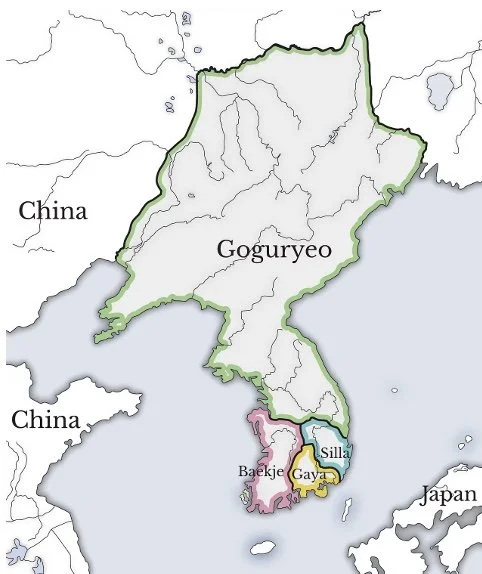
Map of the Korean peninsula during the Three Kingdoms Period
Goguryeo
The Goguryeo Kingdom was founded at around 200-300 BCE. However, according to legend, Jumong, a prince born from Yuhwa (daughter of a river god) and Hae-Mo-Su, a divine deity in Buyeo. Jumong became an exceptional archer. However, he was persecuted in Buyeo, so he fled to a wide river where fish and turtles created a bridge for him. He then founded Goguryeo there.
It was known for having a powerful military, providing a strong defense from its rivals, including Baekje, Silla, and China. It became more unified at around 179-196 CE, with various tribes coming together to create one nation. Historians say that there was a centralized kingdom by the fourth century.
Baekje (also spelled Paekche)
According to legend, this kingdom on the year 18 BCE by King Onjo. He and his brother, Biryu, travelled to the region to escape the conflict in Goguryeo. They each made their own settlements. However, Biryu’s settlement failed so it merged with Onjo’s to create the kingdom.
Baekje was the kingdom with the highest population, at almost four million citizens. The kingdom was a prominent naval power, so it helped spread Buddhism throughout East Asia. Baekje’s culture was influenced by many cultures, including Buddhism and Taoism.
Silla
Silla was said to have been founded by Bak Hyeokgeose, born of an egg laid by a white horse. He ruled six clans by the time he was thirteen and founded the Silla kingdom.
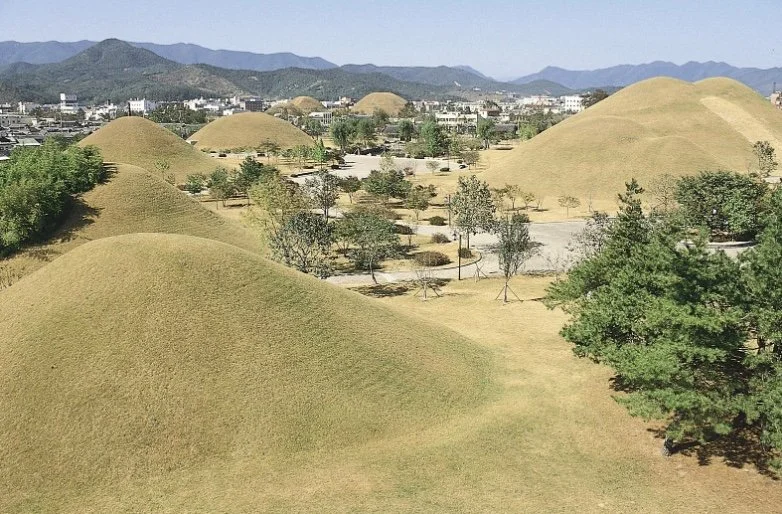
Aerial view of royal Silla tombs
Silla was by far the smallest kingdom, having less than a million inhabitants. It also had a very distinct culture. For example, royal Silla tombs were stone chambers buried in a dirt mound. Although it was the smallest of the kingdoms, it eventually became the kingdom to take over the area, with the help of the Tang Dynasty.